Speed Up Your EIFS: Why Contractors Should Switch to Foam Bond 60

Stucco and EIFS contractors are under more pressure than ever to do more with less. Labor remains hard to find, schedules are tight, and builders expect envelope trades to keep projects moving without sacrificing quality. In AGC’s 2024 workforce survey, 94% of contractors said they had openings for craft workers, and 92% of those firms said those positions were hard to fill. AGC also noted that workforce shortages are contributing to higher costs and longer schedules.
That matters for EIFS crews because wall installation is labor-sensitive. Every extra fastening step, adjustment, or delay compounds across an elevation. When a contractor can simplify board attachment and reduce handling time, that can translate into faster production and better labor efficiency. That is where Tytan Professional Foam Bond 60 becomes a valuable tool in the toolbox.
TYTAN Foam Bond 60 a fast-tack, one-component polyurethane adhesive with 60-second bonding technology, designed to bond common construction materials including wood, metal, foam, gypsum board, and concrete, while remaining safe for EPS, XPS, and ISO foam boards.
EIFS already allows adhesive attachment
For stucco contractors, one of the biggest questions is whether adhesive attachment fits normal EIFS practice. The answer is yes. ASTM’s PB EIFS specification describes EIFS as a system installed over insulation board using adhesive attachment, mechanical attachment, or both.
That does not mean every wall should be installed the same way. Project requirements, substrate conditions, system approvals, manufacturer instructions, code, and engineering all still govern the attachment method. But from a construction practice standpoint, adhesive attachment is not unusual or fringe. It is already part of mainstream EIFS system design.
Faster tack supports faster workflow
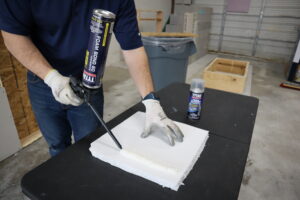
A major bottleneck in EIFS installation is the stop-and-go rhythm that comes from setting boards, checking alignment, fastening, and waiting for enough hold to move on confidently. A faster-grabbing adhesive can help crews keep momentum on the wall.
The benefit of Foam Bond 60 is the fast tack and 60-second bonding. Foam boards bond to the wall substrate in seconds, is secure within about five minutes, and can be used significantly faster than traditional caulk adhesives.
For a stucco contractor, that matters because labor efficiency is often won in small increments. Saving even a modest amount of time on each board or trim component can add up over a full façade. In a labor market where contractors are still struggling to staff jobs adequately, products that simplify installation are not just conveniences; they can become part of a contractor’s operating advantage.
ABC reported in January 2026 that the construction industry would need to attract 349,000 net new workers in 2026 to meet demand. That is a reminder that contractors cannot assume labor challenges will disappear soon. Productivity gains at the material and installation level are becoming more important, not less.
Adhesive attachment can reduce dependence on fasteners
Another practical reason EIFS contractors should look at Foam Bond 60 is the potential to reduce reliance on mechanical fasteners in applications where adhesive attachment is permitted.
There is also a broader installation argument for adhesive fastening. One popular EIFS system advises adhesive fastening versus traditional fasteners. They say adhesive fastening provides a more uniform attachment and can maximize wind-load resistance of the wall cladding, while mechanical attachment concentrates loads around individual fasteners. They also note that overdriven mechanical fasteners can break EPS and reduce wind-load resistance.
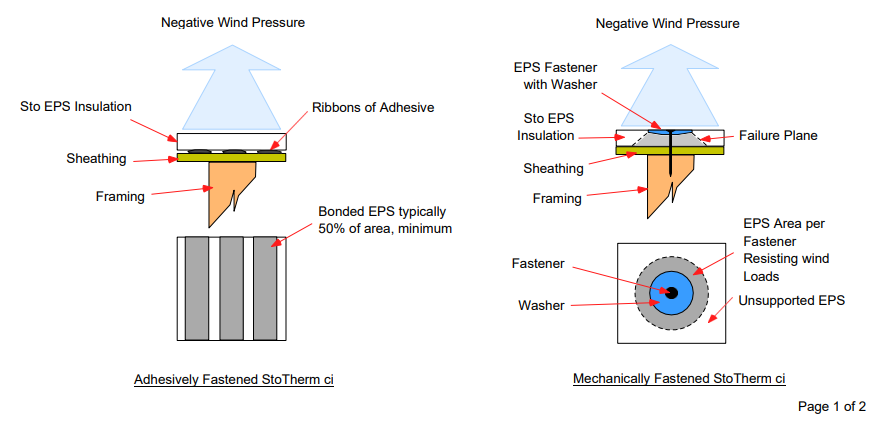
For stucco and EIFS contractors, that can matter in day-to-day field performance. Fewer mechanical fasteners can mean fewer repetitive steps, fewer components to manage, and less opportunity for installer inconsistency. It can also mean less risk of localized damage from fastening errors. That does not replace engineering or manufacturer system requirements, but it does support the idea that adhesive attachment can be a technically sound and labor-saving approach in the right assembly.
Foam-safe chemistry matters in EIFS work
Not every adhesive is appropriate for foam insulation. EIFS contractors need products that will not attack or deform the board. TYTAN Foam Bond 60 is solvent-free and safe for EPS, XPS, and ISO foam board, and that it bonds without degrading or deforming XPS and EPS polystyrene foams.
That is important not only for flat insulation board but also for architectural foam shapes and trim, where dimensional stability and clean adhesion are critical. TYTAN Foam Bond 60 can be used for both rigid foam insulation panels and architectural engineered foam shapes used on building exteriors.
For a contractor, that versatility can simplify the workflow. Instead of switching between different products for board and trim-related foam applications, crews may be able to use one fast-tack adhesive across a broader range of EIFS tasks, subject to the system and job requirements.
Cleaner, simpler installation helps crews stay productive
The best labor-saving products do not just work fast; they reduce friction in the field. Foam Bond 60 is a gun-applied adhesive intended for routine construction use, and it as an easier, faster alternative to more traditional adhesive approaches.
That simplicity matters. With labor harder to find and experienced installers in high demand, contractors benefit from products that are easier to train on, easier to repeat consistently, and less physically tedious than heavily fastener-dependent workflows. AGC’s survey findings reinforce the reality behind this: contractors are still operating in a market where skilled craft labor is scarce and project schedules are being affected.
In that environment, a faster, simpler attachment method is not just about speed for speed’s sake. It is about helping crews stay efficient and helping foremen keep production predictable.
The bottom line
EIFS contractors do not need more complexity. They need systems and materials that help them move faster, work cleaner, and make better use of limited labor.
Industry standards and manufacturer guidance already recognize adhesive attachment as a normal EIFS construction practice. Meanwhile, major construction organizations continue to report severe labor shortages and schedule pressure. Against that backdrop, an adhesive like Tytan Professional Foam Bond 60 turns a problem into an opportunity: a 60-second fast-tack, foam-safe, solvent-free adhesive that can help reduce fasteners and speed installation in appropriate applications.
For stucco contractors looking to improve productivity and present a more efficient installation approach, Foam Bond 60 is a practical way to help speed up EIFS.
Sources
Associated General Contractors of America – 2024 Workforce Survey Analysis (link)
Associated Builders and Contractors – Construction Industry Must Attract 349,000 Workers in 2026 Despite Macroeconomic Headwinds (link)
ASTM E2568-17 – Standard Specification for PB Exterior Insulation and Finish Systems (link)
Sto – Technical Hotline “Adhesive versus Mechanical Fastening” (link)
